Meditation & Cultivation
Taoist practices focus on cultivating vital energy (Qi), balancing the body and mind, and achieving longevity and spiritual immortality.
Taoist Meditation
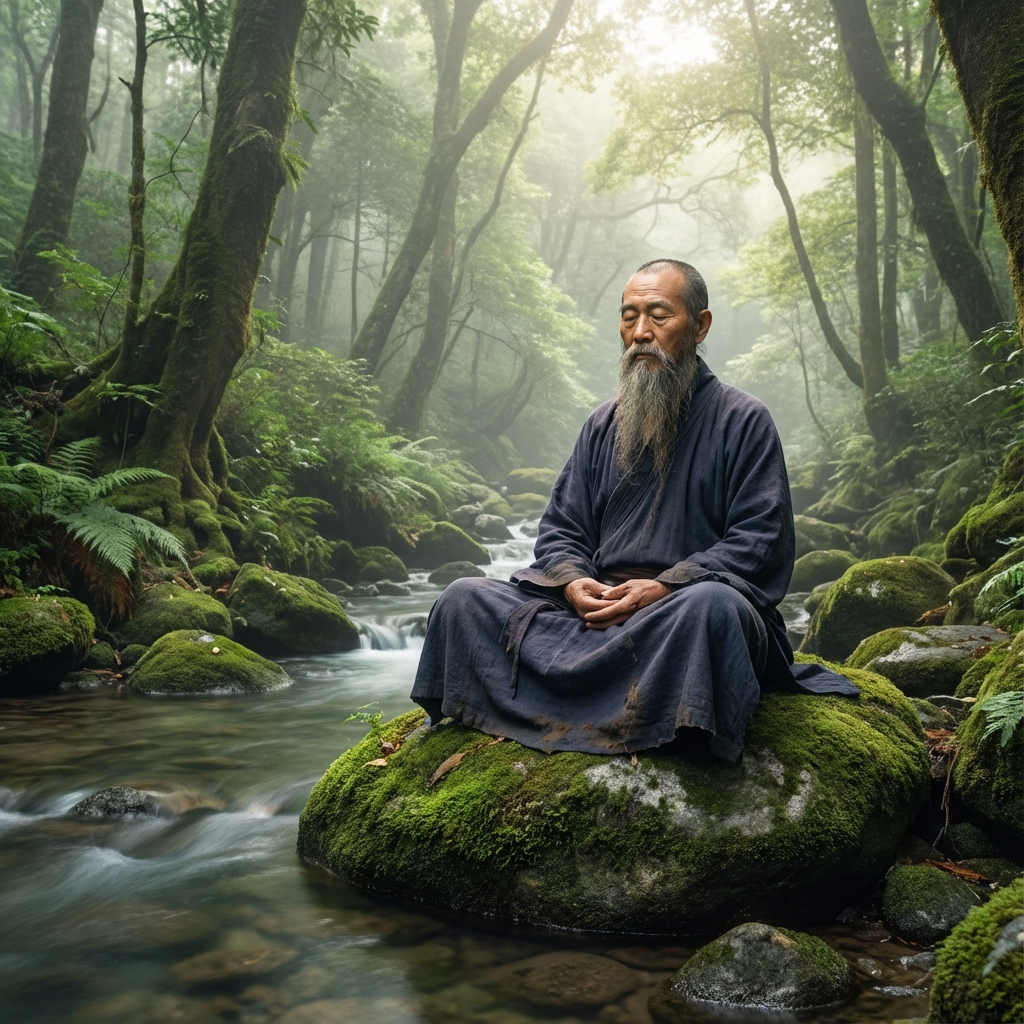
Taoist meditation encompasses a rich family of contemplative techniques designed to quiet the restless mind, dissolve the boundaries of the ego, and merge individual consciousness with the boundless Tao. Central among these is Zuowang, or Sitting in Oblivion, in which the practitioner progressively releases attachment to the body, thoughts, and even the sense of self, arriving at a state of luminous emptiness. Other methods include Shouyi (guarding the One), Neiguan (inner observation), and various forms of visualization and breathwork that cultivate the subtle energies within the body's inner landscape.
historyHistory
Rooted in practices dating back over two thousand years to the philosophical contemplation of Laozi and Zhuangzi, Taoist meditation evolved through the Shangqing revelations of the 4th century, the Tang Dynasty's integration of Buddhist meditation techniques, and the Song Dynasty's systematization through internal alchemy.
infoKey Details
Practitioners harmonize with the Tao through techniques of energy cultivation, breath awareness, and visualization. Core methods include Zuowang (sitting in oblivion), Neiguan (inner observation), Shouyi (guarding the One), and the circulation of Qi through the body's meridian pathways.
favoriteBenefits
Improved cardiovascular health and circulation, measurably reduced stress and anxiety, enhanced mental clarity and concentration, deeper self-awareness, and the cultivation of a profound inner stillness that practitioners describe as direct communion with the Tao.
Qigong & Tai Chi
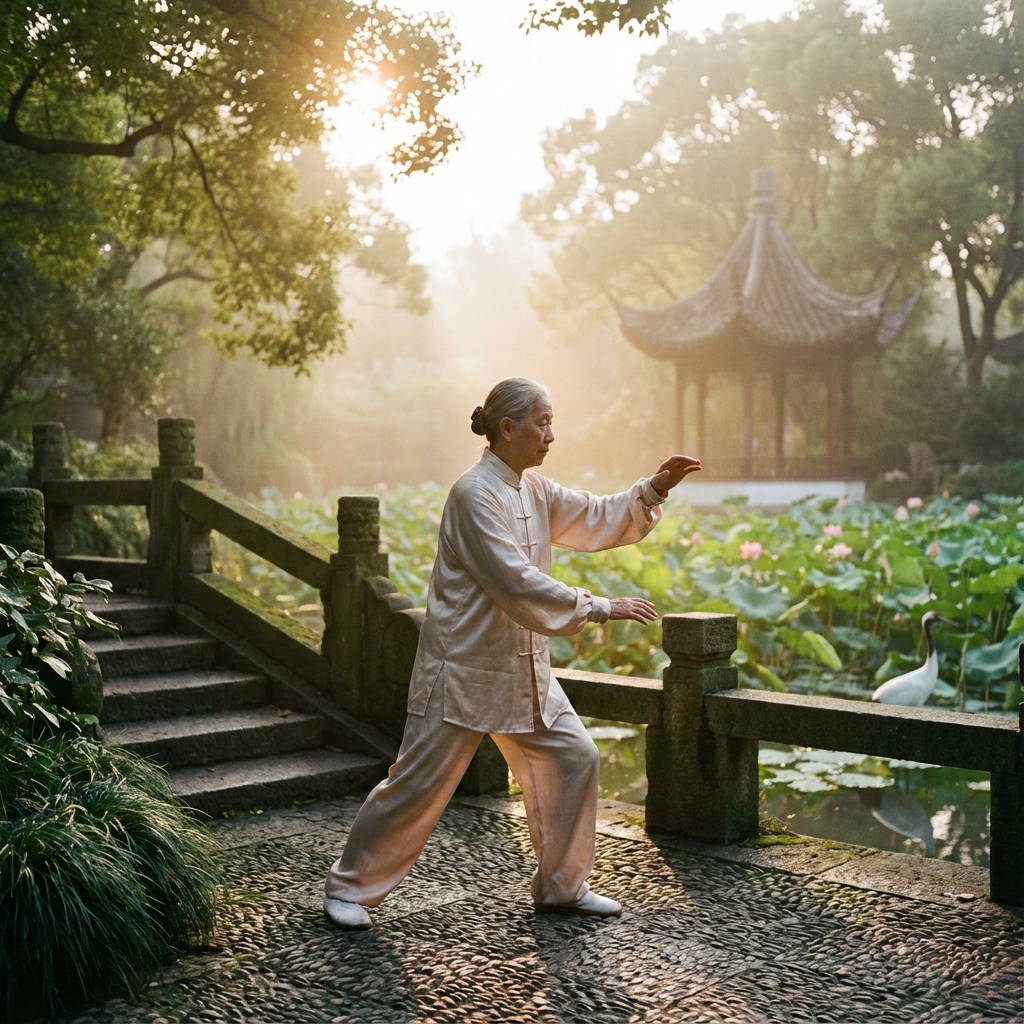
Qigong and Tai Chi are movement-based practices that harmonize body posture, flowing movement, rhythmic breathing, and focused intention to cultivate, circulate, and balance the body's vital energy (Qi). Rooted in the ancient Taoist art of Daoyin (guiding and stretching), these practices range from gentle, meditative forms performed in stillness to dynamic sequences that develop martial power. Tai Chi, originally a martial art, has evolved into one of the world's most widely practiced health exercises, while Qigong encompasses thousands of distinct forms developed by Taoist, Buddhist, Confucian, and medical traditions over millennia.
historyHistory
The roots of Qigong stretch back over five thousand years to the shamanic dances and Daoyin exercises of ancient China. The Mawangdui Daoyin Tu (168 BCE) provides the earliest illustrated guide. Taoist Qigong is considered China's original method for developing inner awareness of Qi, later enriched by Buddhist and medical traditions.
infoKey Details
Combines coordinated physical movement, controlled breathing, and mental concentration. Practices are classified as active (dong gong, involving movement) or passive (jing gong, performed in stillness). Key principles include song (relaxation), natural breathing, rooting through the feet, and the smooth flow of Qi through the body's meridians.
favoriteBenefits
Clinically documented benefits include reduced stress, improved immune function, better balance and flexibility, lower blood pressure, and enhanced respiratory capacity. Practitioners report increased vitality, calmer emotional states, heightened body awareness, and a deepening sense of connection to the natural world.
Neidan (Internal Alchemy)
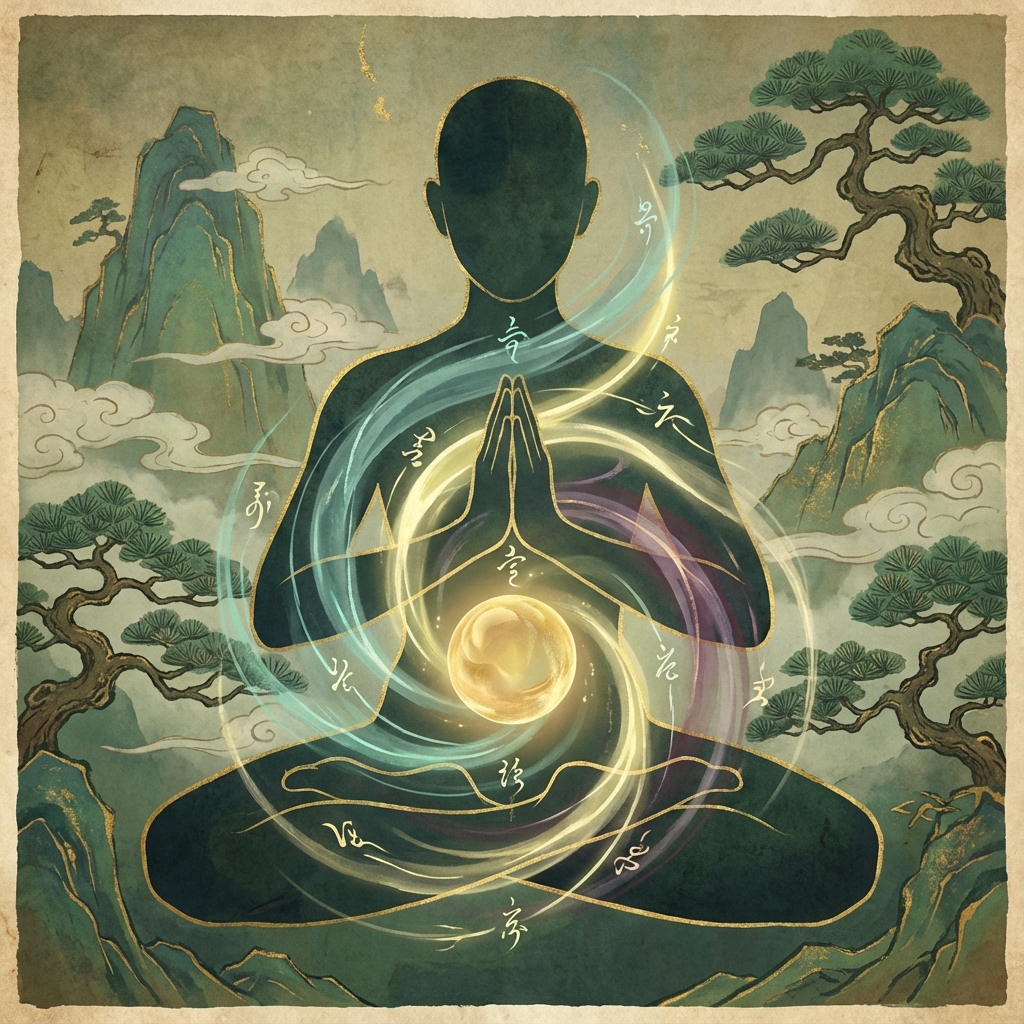
Neidan, or internal alchemy, is the crown jewel of Taoist spiritual practice, a sophisticated system of meditation, breathwork, and visualization that uses the metaphorical language of alchemy to describe the transformation of the practitioner's vital energies. Where external alchemy (waidan) sought to compound physical elixirs of immortality in a laboratory, Neidan turns the body itself into the alchemical furnace, systematically refining Jing (essence) into Qi (energy), Qi into Shen (spirit), and Shen into the Void, reversing the process of creation to return to the primordial unity of the Tao.
historyHistory
Emerging as a distinct tradition from the 8th century CE, Neidan drew on the symbolic framework of the Cantong Qi and the meditation practices of the Shangqing school. It reached full maturity during the Song and Yuan dynasties through masters like Zhang Boduan, whose Wuzhen Pian codified the southern lineage.
infoKey Details
The practice views the body as an alchemical cauldron for refining the Three Treasures: Jing (essence), Qi (vital energy), and Shen (spirit). Through a carefully staged process, the practitioner refines Jing into Qi, Qi into Shen, and finally returns Shen to the Void (xu), achieving reunion with the Tao.
favoriteBenefits
Practitioners report increased vitality and physical resilience, enhanced mental clarity and emotional stability, profound states of meditative absorption, and a deepened awareness of the subtle energetic dimensions of existence. The traditional ultimate goal is spiritual immortality.
Taoist Rituals & Ceremonies
Taoist rituals, known as Zhai (purification fasts) and Jiao (offerings), form the liturgical heart of religious Taoism. These elaborate ceremonies, conducted by ordained priests in ornate vestments, serve to renew the cosmic order, purify communities, honor deities, and provide blessings for the living and salvation for the deceased. Ranging from simple daily devotions of incense offering and scripture chanting to grand community Jiao festivals lasting several days, these rituals create a sacred space where heaven, earth, and humanity converge. The priest acts as a mediator between the human and divine realms, using mudras, chants, talismans, and sacred dance to invoke celestial powers.
historyHistory
Taoist ritual traditions trace back to the Celestial Masters movement of the 2nd century CE. The Lingbao school of the 5th century developed elaborate liturgies that became the foundation of all subsequent Taoist ritual. The current ritual traditions were largely codified during the Song Dynasty.
infoKey Details
Major ritual forms include Zhai (purification and abstinence), Jiao (cosmic renewal offerings), funeral rites (du wang), and daily temple devotions. Priests employ a rich repertoire of chanting, mudras (hand seals), sacred dance steps (bugang), talismanic writing, and the burning of memorials to communicate with the celestial bureaucracy.
favoriteBenefits
Community cohesion and spiritual renewal, purification of negative influences, blessings for health and prosperity, honoring ancestors and ensuring their peace, and the renewal of the bond between the human community and the cosmic order.
Feng Shui
Feng Shui, literally Wind and Water, is the ancient Chinese art and science of harmonizing human beings with their surrounding environment. Rooted in the Taoist understanding that the landscape is alive with flowing Qi, Feng Shui practitioners read the patterns of mountains, rivers, winds, and underground water courses to determine the most auspicious placement of buildings, tombs, and interior furnishings. The practice encompasses two major schools: the Form School, which analyzes the physical contours of the landscape, and the Compass School, which uses the Luopan compass to calculate directional and temporal influences based on the Yijing, the Five Phases, and the Heavenly Stems and Earthly Branches.
historyHistory
The origins of Feng Shui extend back to the Neolithic period, with early forms of site selection evident in the orientation of ancient settlements. Guo Pu's Zangshu (Book of Burial, 4th century CE) is considered the foundational text. The Form and Compass schools crystallized during the Tang and Song dynasties.
infoKey Details
Practitioners analyze the flow of Qi through landforms, buildings, and interior spaces using principles of yin-yang balance, the Five Phases (wuxing), the eight trigrams (bagua), and the Luopan compass. Key concepts include the dragon and tiger formations, the ming tang (bright hall), and the balance of water and mountain energies.
favoriteBenefits
Optimized living and working environments that promote health and well-being, improved flow of beneficial Qi through spaces, enhanced harmony between inhabitants and their surroundings, and a deeper awareness of the subtle environmental factors that influence daily life.
Yangsheng (Nourishing Life)
Yangsheng, the art of nourishing life, is the comprehensive Taoist approach to health cultivation that integrates dietary practice, seasonal living, exercise, sexual cultivation, herbal medicine, and mental hygiene into a unified system for preserving vitality and extending lifespan. Unlike Western medicine's focus on treating disease, Yangsheng emphasizes prevention and the maintenance of balance before illness can arise. Guided by the principle of following nature (shun zi ran), practitioners attune their daily habits to the rhythms of the seasons, the cycles of yin and yang, and the specific needs of their individual constitution, treating the body as a garden to be carefully tended rather than a machine to be repaired.
historyHistory
Yangsheng principles appear in the earliest Chinese medical texts, including the Huangdi Neijing (Yellow Emperor's Inner Canon, c. 2nd century BCE). The Taoist tradition enriched these with Daoyin exercises, breathing techniques, and dietary alchemy. Ge Hong, Sun Simiao, and other Taoist physicians made major contributions.
infoKey Details
Encompasses dietary cultivation (shiliao), seasonal adjustment of habits and activities, Daoyin exercises and self-massage, breathing practices (tuna), herbal supplementation, sleep hygiene, emotional regulation, and the harmonization of daily life with the cycles of yin-yang and the Five Phases.
favoriteBenefits
Enhanced overall vitality and immune resilience, prevention of illness through balanced living, improved digestion and sleep quality, greater emotional equilibrium, and the cultivation of a long, healthy life in harmony with the natural rhythms of heaven and earth.